How do you get an entire production line to Thailand?
Suppose a manufacturer needs to relocate a valuable machine, or even an entire production line, to the other side of the world. At first, the task sounds simple: pack the machinery and transport it to its new location. But industrial equipment cannot simply be wrapped in bubble wrap, boxed up and sent off. The packaging must be designed with the machine’s dimensions, weight and sensitivity in mind, as well as the journey ahead. Packaging and transport are also often handled by two different companies. That may not be a problem, as long as everything goes smoothly.
But what happens if the machine arrives damaged?
The packer says something must have happened during transport. The carrier suggests the packaging may have been inadequate. Meanwhile, the customer is left with a damaged machine, a slipping deadline and two providers looking to each other for an explanation. At SPED-PACK, these are precisely the situations we want to avoid.
One package, two areas of expertise, one team
Within the SPED-PACK Group, we handle both packaging and transport. Separate specialist teams carry out the two tasks, working closely together.
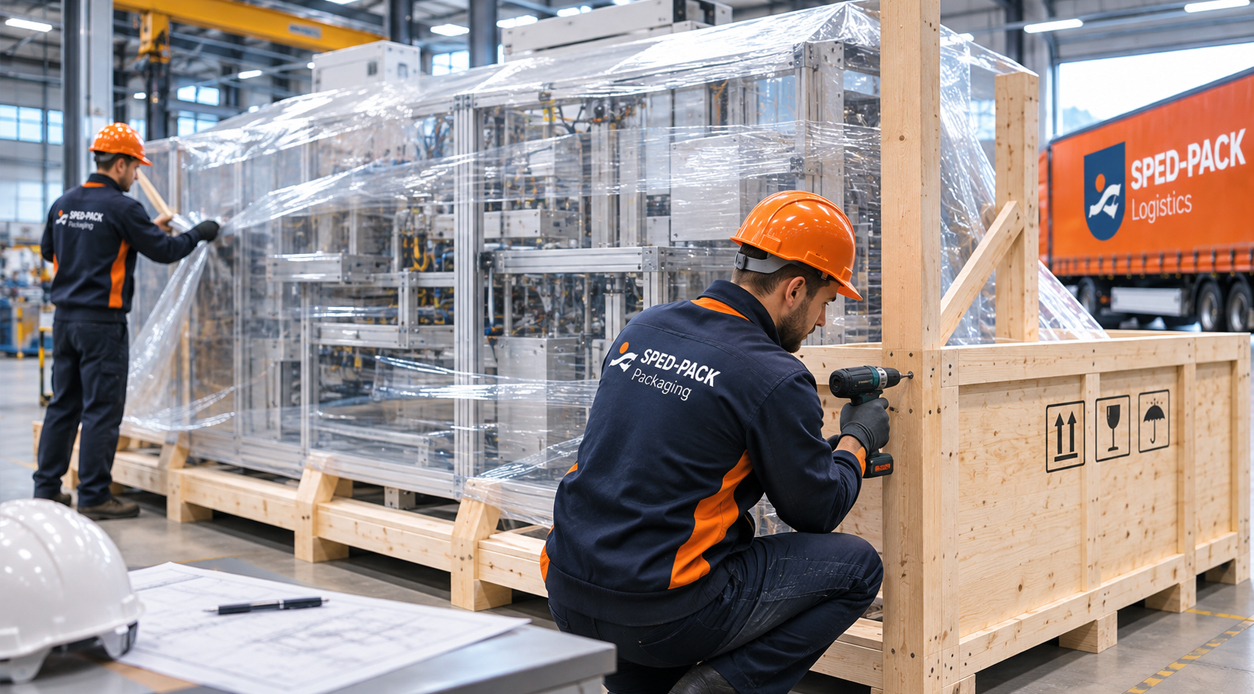
SPED-PACK Packaging’s engineers design the packaging needed to transport each machine safely. We manufacture the packaging materials ourselves, so we can tailor the packaging to unusually sized or sensitive equipment instead of relying on off-the-shelf solutions. When the assignment calls for it, our packing team works at the customer’s site. SPED-PACK Logistics then organises transport of the packaged machine to its destination.
What matters most, however, is not simply having specialists in both areas. It is being able to design the packaging with the transport conditions in mind from the outset. We do not have to work out afterwards how to move an already packaged machine or protect the cargo on a long journey: the two teams can work together from the planning stage.
A production line’s journey from Hungary to Thailand
A good example is a Maxon Motor project involving the relocation of an entire production line from the company’s Hungarian facility to its factory in Thailand. An assignment like this involves far more than putting a single crate on a truck. The production equipment must be packaged to ensure adequate protection throughout a long international journey.
We began at Maxon’s Hungarian site. SPED-PACK Packaging’s specialists packaged the production equipment on site, tailoring their work to each machine’s characteristics and the planned transport. SPED-PACK Logistics then organised delivery of the cargo to Thailand.
The project illustrates the benefits of coordinating packaging and logistics. The packaging team knows exactly which transport conditions to prepare for, while the logistics specialists can account for the packaging’s characteristics during planning.
Whose job is it? Ours.
A project like this requires extensive coordination: dimensions, weights, packaging requirements, transport conditions and deadlines all need to be addressed. When packaging and transport are handled by two independent providers, the customer also has to coordinate these details.
We handle both tasks within the SPED-PACK Group. The customer receives a coordinated service without having to act as an intermediary between the packaging team and the transport planners. Of course, this does not mean that nothing unexpected can happen during a complex international shipment. But if something needs to be discussed or changed, the customer does not have to seek a solution separately with two independent companies.
The goal is not a packaged machine, but a machine that arrives intact
We believe that packaging for industrial equipment cannot be assessed in isolation. A machine leaving the factory neatly and carefully packaged does not mean the assignment is anywhere near complete. The packaging must serve the entire journey, while transport must account for the value and sensitivity of the equipment involved. That is why we like to manage the two together. Ultimately, our customer does not simply need a well-packaged machine and a completed shipment: they need their equipment to arrive safely where it will be used next.