Nails in the floor of our trailer?
There are a few things a carrier would rather not see. Someone hammering nails into the floor of its trailer, for example.
Understandably so: vehicle maintenance is expensive enough, and repairing a damaged floor adds another cost. It is no coincidence that many carriers explicitly prohibit this way of securing a load. At SPED-PACK Logistics, however, we allow one of our customers to do it regularly. And we have a good reason.
Several tonnes of cable that must not move
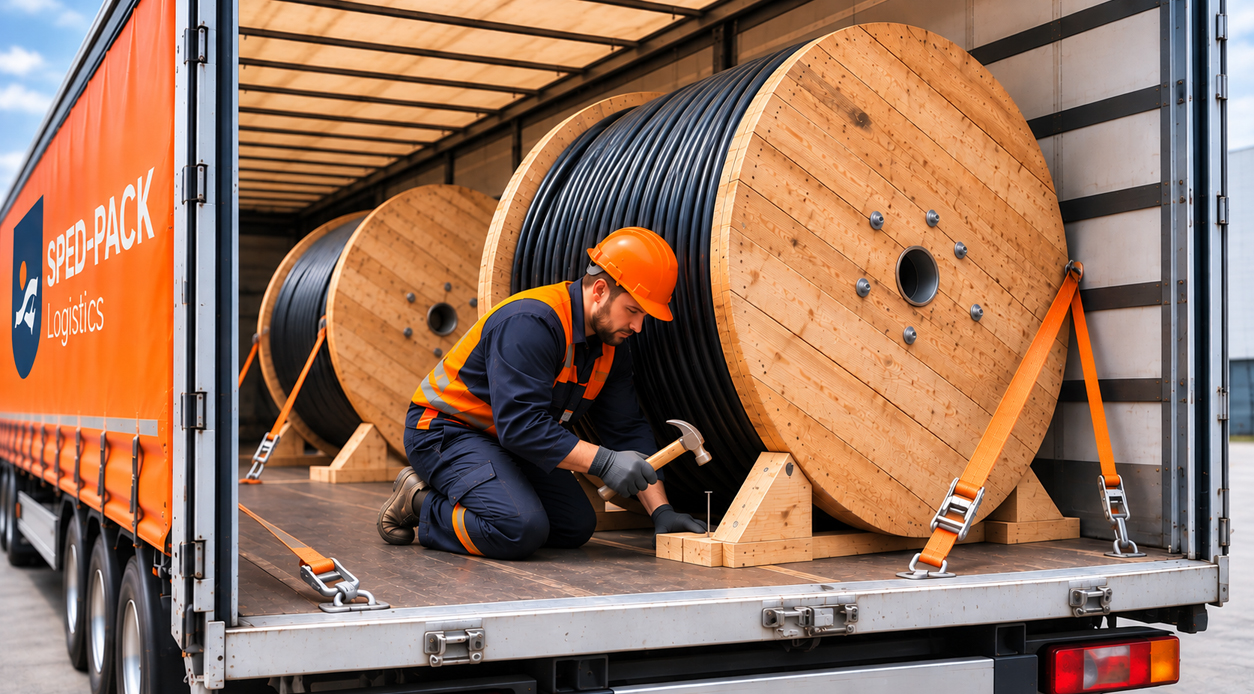
We transport cable drums for Prysmian. These are the enormous cylindrical reels onto which cables for industrial and energy applications are wound. Each drum weighs a considerable amount, and its shape is far from ideal for transport. Just imagine what could happen if a cylindrical load weighing several tonnes shifted during braking or cornering. Securing cable drums properly is therefore essential, both to protect the goods and to keep the vehicle and other road users safe.
Our customer uses a proven solution: restraints nailed to the trailer floor prevent the drums from rolling. The method is effective, but it also puts greater strain on the trailer floor.
We take on what others see as a problem
Many carriers would say that they do not allow this. They would ask for the cargo to be secured differently to avoid damage to the vehicle floor. That is a perfectly understandable position.
We take a different approach. For Prysmian, this is an established and proven loading and securing procedure, so we do not expect them to change it just for us. Instead, we accept the greater wear on the floor and the additional maintenance costs involved. Naturally, the vehicle’s roadworthiness and the safe securing of the cargo remain essential requirements.
The carrier is not always right
A logistics provider naturally has its own processes, rules and tried-and-tested solutions. We need these to work efficiently and safely. At the same time, we must remember that our customer also has established operating procedures, and it is not necessarily always the customer who should adapt to us.
Cable-drum transport is a good example. We could insist on our own preferences and request a different securing method. Instead, we accept that the customer’s proven practice takes priority in this case, and adapt our operations accordingly. It costs us a little more, but our partner does not have to reorganise loading on our account.
Sometimes a little flexibility is worth more than an undamaged floor
Of course, this does not mean we automatically say yes to every customer request. Safety and technical requirements cannot be compromised. But if a request is feasible and makes the customer’s work significantly easier, we believe it is worth finding a solution, even if it costs us a little more time or money.
For Prysmian, that happens to mean occasionally repairing our trailer floors. We can live with that. After all, the trailer should fit the transport job, not the other way round.